Retained earnings: What they are and how to account for them Sage Advice Ireland

This is particularly valuable https://www.apsimplex.com.my/bookkeeping/streamline-your-finances-today/ for technology and pharmaceutical companies that rely on constant innovation to stay competitive. Even though some refer to retained earnings appropriations as retained earnings reserves, using the term reserves is discouraged. Because of this, net income does not reflect the actual cash a company generated during the period. Net income — also called net profit or net earnings — is the amount of profit a company retains after deducting all expenses.
- Whether you are a new business owner or a seasoned entrepreneur, understanding retained earnings is essential for effective financial management.
- The increase in expenses in the amount of $1,000 combined with the $300 decrease in income tax expense results in a net $700 decrease in net income for the prior period.
- Changes in unappropriated retained earnings usually consist of the addition of net income (or deduction of net loss) and the deduction of dividends and appropriations.
- This practice is often a strategic move by businesses to reinvest in growth opportunities, bolster financial stability, or weather economic downturns.
- It’s also sometimes called the statement of shareholders’ equity or the statement of owner’s equity, depending on the business structure.
- Investors who have invested in a Company gain either from dividend payments or the share price increase.
Is Retained Earnings a Revenue? Demystifying the Financial Jargon

If your company has outstanding loans or financial obligations, retained earnings can be used to pay down this debt. Reducing debt with retained earnings can help improve the company’s financial stability and reduce interest payments. Finally, add the current net income/earnings figure, listed on your Q3 income statement/profit and loss, to the retained earnings figure for Q3. Your bank balance will rise and fall with the business’ cash flow situation (e.g. received payments and spending), but the retained earnings are only affected by the current period’s net income/loss figure. The net income contributes to retained earnings but, as mentioned, retained earnings are cumulative across accounting periods, subject to dividends being taken out, and accounted for as an asset. In that case, your savings account balance (retained earnings) will increase because you were able to tuck money away.
What Is Net Income?
By properly accounting for comprehensive income, businesses ensure retained earnings that all relevant financial information is accurately reflected in the retained earnings balance. Investors who have invested in a Company gain either from dividend payments or the share price increase. In contrast, a growing Company is expected to retain the income and invest in future business, thus expecting an increase in the share price. As the firms pay a dividend to the shareholders despite losses, the retained sum decreases.

Step 4: Subtract Dividends Paid Out to Investors
- Gross income shows revenue before expenses, while net income reflects the company’s true profitability after all deductions.
- When a company consistently experiences net losses, those losses deplete its retained earnings.
- A growing retained earnings balance shows there is strong financial performance and profitability within the company.
- The statement of retained earnings reconciles the beginning and ending retained earnings for the period, using information such as net income from the other financial statements.
- This can increase investor confidence and may even allow your company to obtain more favourable lending terms if you decide to take out a loan in the future.
- Generally, it is better to have higher retained earnings as it provides a larger pool of funds for future investments and expansion.
- Corporations differ from sole proprietorships and partnerships in that their operations are more complex, often due to size.
The first is paid-in capital, or contributed capital—consisting of amounts paid in by owners. The second category is earned capital, consisting of amounts earned by the corporation as part of business operations. On the other hand, retained earnings represent the accumulated profits or losses of the company that have not been distributed to shareholders in the form of dividends. Retained earnings are, essentially, the financial reservoir of the company, built over time through the profits generated from its operations.
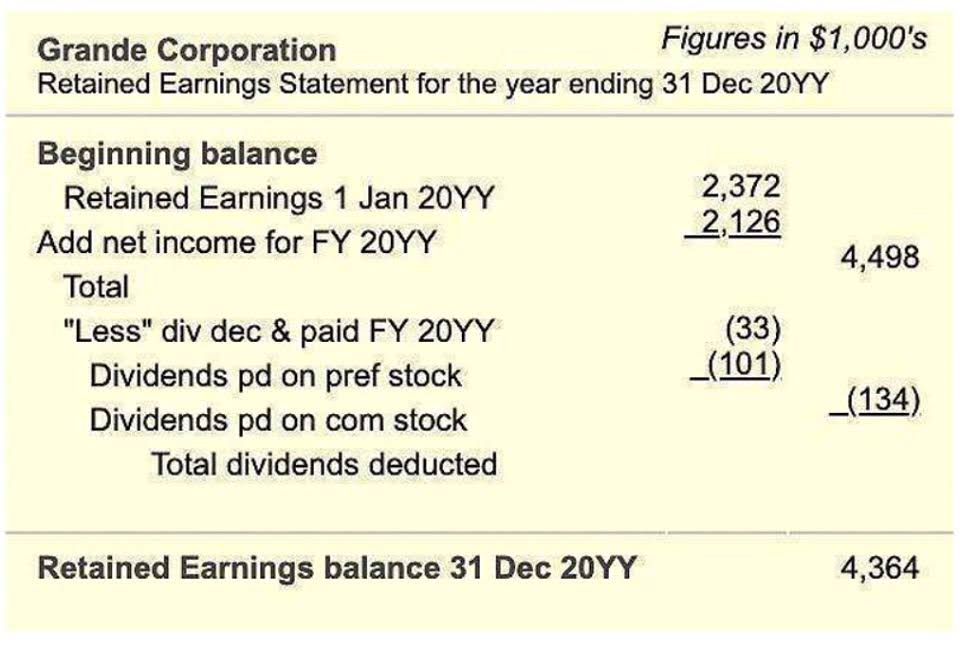
Prior Period Adjustments
Retained earnings being low indicates that much of the company’s profits are paid out to shareholders in dividends. For newer companies looking to expand, it’s common to see higher retained earnings, since they will focus on reinvesting profit into the business. Now, if you paid out dividends, subtract them and total fixed assets the ending balance. This is the new balance in the retained earnings account and it will be displayed on the balance sheet as of the last day of the current accounting period. Because RE is calculated to date, they accumulate from one period to the next.